
Is Poor HR Management the Hidden Barrier to Scaling Your Business?
Struggling to scale your business? You could be missing an important point: your HR management. Poor practices in hiring, training, and performance can silently sabotage your growth. Learn how poor HR practices result in high employee turnover, low morale, and increased expenses. Find out what obstacles might be limiting your progress and learn practical methods to change how you handle HR, improve HR efficiency, and grow your business. Your business’s success might rely on it, including how well you handle diversity among employees and keep them from leaving. Ready to dive in?
Definition of HR Management
HR management is the careful planning and handling of all parts of a company’s staff, including hiring and training, among other things.
Effective HR management involves essential tasks like hiring, improving employee skills, keeping staff, following labor regulations, and workforce management.
For example, a small tech startup might use LinkedIn Recruiter to hire employees and follow an onboarding checklist to make training consistent.
On the other hand, a bigger company might use performance management tools like Workday to track employee progress and support retention by creating specific development programs.
By matching these practices with the company’s objectives, HR makes sure both the employees and the business succeed, ensuring organizational alignment.
Importance of HR in Business Growth
Good HR practices can help a business grow, as shown by companies like Google, which use strong HR strategies and leadership development to stay ahead of competitors.
For instance, after implementing a mentorship program and flexible work arrangements, a tech company increased employee retention rates by 25% and productivity by 20%. HR metrics such as average time to fill positions and employee satisfaction scores can help assess the impact of these initiatives, ensuring that HR alignment is achieved.
Tools like BambooHR and Gusto facilitate tracking these metrics, enabling HR teams to make data-driven decisions. By concentrating on hiring strategically and creating a positive workplace environment, organizations can adjust quickly to changing market needs, thus improving their business resilience.
The Role of HR in Scaling a Business

HR is essential for business growth by hiring the right people, implementing strategic HR, and creating structures that help the company expand. For an extensive analysis of this trend, our study on using HR data to drive smarter business expansion explores how data-driven decisions can further enhance these strategies.
Recruitment and Talent Acquisition
Talent acquisition is a strategic initiative that includes identifying, attracting, and hiring the right talent to meet an organization’s growing demands, thus building a strong talent pipeline.
To make hiring simpler, establish specific measures like aiming to fill positions within 42 days on average, ensuring operational efficiency.
Use LinkedIn Recruiter, which has a monthly fee of $1200, to quickly locate candidates.
Consider hosting virtual job fairs or using employee referral programs to find more job applicants.
Avoid common pitfalls like lengthy interview processes by prioritizing candidate experience-opt for structured interviews to keep evaluations efficient. Worth exploring: Hire Smarter: 9 Do’s and 5 Don’ts For Hiring Employees.
These methods support a proactive hiring approach, helping you hire top candidates quickly and improve your recruitment strategies.
Employee Development and Training
Investing in employee development through structured training programs can increase employee engagement by up to 70% according to recent studies.
Online courses via platforms like LinkedIn Learning ($29.99/month) and Coursera can be effective ways to upskill your team. For example, a software company that implemented a 6-month mentorship program alongside online training saw a 25% increase in project completion rates.
Combining these resources helps build a complete learning experience, letting employees learn at their own speed while getting individual support, enhancing staff development. Tracking metrics such as retention costs and employee performance scores will help determine the return on investment for these initiatives and improve HR effectiveness.
Performance Management Systems
A good performance management system aligns employee objectives with company goals, supports continuous feedback and development, and encourages better teamwork.
Important parts include feedback from all directions and goal-setting methods like OKRs (Objectives and Key Results). Tools like Lattice, which costs $12 monthly for each user, simplify the process by enabling employees to set clear goals and get feedback from various sources, improving performance indicators.
For instance, Company X implemented OKRs through Lattice and saw a 25% increase in employee engagement in just one quarter. Regular meetings promote ongoing communication between managers and teams, leading to improved performance and supporting communication within the organization.
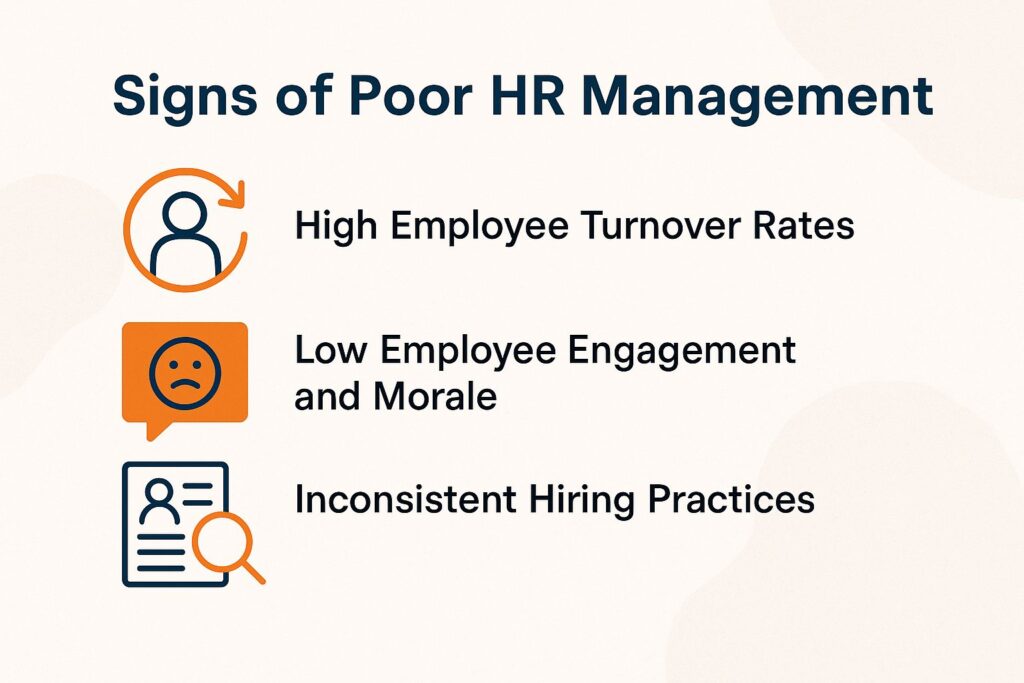
Signs of Poor HR Management
Spotting indicators of bad HR practices can prevent bigger problems in the business, enabling quick corrective actions and ensuring effective resource allocation. If you’re interested, you might find 10 ways growing businesses can avoid HR headaches in 2025 particularly useful in addressing these issues.
High Employee Turnover Rates
Employee turnover rates higher than 15% can indicate problems in human resources management and impact changes in business operations.
For instance, a 2021 study revealed that the average cost of replacing an employee is approximately 33% of their annual salary. A notable case is XYZ Corp., which experienced a 25% turnover rate.
By implementing an employee engagement program and offering career development opportunities, they reduced turnover to 10% over two years and improved staff engagement. They used tools like employee surveys and performance reviews to collect feedback and change their strategies based on the results.
These proactive steps can greatly improve employee retention and make the company culture and performance better.
Low Employee Engagement and Morale
Employee engagement often drops below 30%, which can slow down business growth and indicate weak HR strategies and not enough support for employees.
To address this issue, companies can implement targeted strategies such as regular Gallup surveys to assess employee sentiment and improve employee relations.
A tech company increased participation by 25% by asking for feedback and openly adjusting based on survey findings.
Incorporating flexible work policies also led to a 15% increase in morale at a retail company.
By measuring engagement through metrics like employee Net Promoter Score (eNPS), businesses can identify weak areas and monitor the effectiveness of their initiatives, ensuring sustainable growth and a more motivated workforce.
Inconsistent Hiring Practices
Inconsistent hiring practices can lead to poor hiring decisions, with studies showing that 38% of hires fail within the first 18 months, causing operational challenges.
To combat these issues, implement structured interviews that focus on role-specific competencies. Using standardized questions keeps things consistent and helps limit bias.
Tools like Greenhouse allow you to create customizable interview kits, facilitating uniformity across your hiring team. Train interviewers on recognizing unconscious biases to promote fair evaluations.
Defining clear standards for assessing candidates can make decision-making better and help monitor outcomes over time, resulting in an improved hiring process and following workplace rules.
Impact of Poor HR Management on Business Scaling

The effects of bad HR management go past short-term issues and greatly impact a company’s capability to grow successfully and maintain business strategy.
Decreased Productivity
Poor HR practices can lead to a decrease in employee productivity, with studies indicating a 20% drop in output in poorly managed teams, affecting operational efficiency.
For example, a company with high staff turnover because of poor onboarding noticed a 30% rise in productivity after starting a detailed training program.
Utilizing tools like BambooHR for employee feedback and performance tracking helped managers identify key pain points.
Another case study showed that a firm increased teamwork by 25% when they started regular check-ins and created a clear plan for resolving conflicts.
By focusing on effective HR strategies, organizations create a positive work environment and increase overall productivity, ensuring business performance.
Negative Company Culture
A negative company culture can result from ineffective HR, leading to disengagement and low morale among employees, challenging their job satisfaction.
Addressing cultural misalignments begins with clear communication.
For instance, Google revamped its hiring processes by integrating behavioral interviews, allowing for a better cultural fit assessment and ensuring strategic planning. Similarly, Zappos emphasizes cultural alignment in recruitment, offering new hires $2,000 to leave if they don’t feel at home.
Organizations like IBM have regular feedback loops and training programs to promote inclusivity and flexibility, ensuring better organizational development. These specific HR efforts improve employee retention and build a more involved team, leading to a positive company culture.
Increased Costs
Inefficient HR practices can inflate operational costs, with estimates showing that poor hiring alone can cost companies up to $240,000 per bad hire, impacting HR audits.
To lower these costs, companies should use structured interview techniques, with tools like Greenhouse or Lever to track candidates.
Using personality tests like the Predictive Index can improve the accuracy of hiring. Regularly reviewing onboarding practices is essential; a well-structured onboarding plan can improve retention rates by up to 70%, ensuring better employee onboarding.
Training HR teams on best practices can reduce turnover significantly, with organizations experiencing a 50% decrease in hiring costs by focusing on employee engagement strategies and enhancing workforce analytics.
Identifying Hidden Barriers in HR Practices
Identifying hidden problems in HR practices is important for companies wanting to better manage their employees and improve their human capital.

Assessing Current HR Policies
Regular assessments of current HR policies can reveal gaps that hinder organizational effectiveness and employee satisfaction.
To identify these gaps effectively, implement employee surveys using tools like SurveyMonkey or Google Forms, ensuring effective feedback mechanisms. This lets you collect feedback directly from employees about their experiences and views on HR policies.
Review company policies by checking them against standard guidelines and addressing compliance issues. Tools like BambooHR can help track and analyze employee feedback over time, enabling continuous improvement in strategic HR practices.
By setting up a system for input and response, you keep your team focused on business targets and encourage open communication strategies, which helps keep employees involved and reduces turnover while supporting retention strategies.
Gathering Employee Feedback for HR Effectiveness
Getting feedback from employees through regular methods can reveal important information that helps improve human resources, address skill gaps, and keep employees involved in organizational growth.
To collect and use employee feedback, think about using anonymous surveys with tools like SurveyMonkey or Google Forms. These feedback systems allow employees to share their thoughts anonymously, increasing their support for the company.
Set up quarterly meetings to talk about feedback in detail and encourage open communication strategies. For actionable results, share examples of responses leading to changes, such as a request for workplace flexibility that led to a successful pilot program in terms of employee wellness.
Establishing clear follow-up actions based on feedback demonstrates to employees that their voices are valued, enhancing engagement and trust while supporting team collaboration.
Strategies for Improving HR Management and Human Resource Planning

Better HR management, including effective talent management, can fully use employees’ abilities and support long-term business growth with strategic alliances. For businesses looking to enhance these processes, exploring related callout: HR Management | A Guide to Simplify Business Operations can provide insightful strategies for optimizing HR workflows.
Implementing Effective Recruitment Strategies for Organizational Structure
Using effective hiring methods can greatly improve the quality of new employees, which leads to better company performance, aligning with business objectives.
Two effective methods to think about are hiring with a focus on varied backgrounds, which improves representation and welcoming environments, and building a strong company image.
To support a wide range of backgrounds and equal opportunities, try using tools like LinkedIn Talent Solutions. It provides job ads aimed at a diverse group of applicants for about $10,000 annually, aiding in scaling business efforts.
To build your company’s image, create an interesting story about your company and share employee experiences on social media and your careers page.
HR metrics, such as a 30% rise in candidate diversity and a 50% rise in employee engagement scores, show success after using these recruitment strategies.
Enhancing Employee Training Programs for Skills Development
Enhancing employee training programs for skills development can yield a 30% increase in job performance according to industry reports.
Companies like IBM and AT&T have successfully started using e-learning services like Coursera for Business, which costs around $4,000 each year, to provide specific training that matches what employees need.
Using both practical experience and online courses, including training and development, keeps employees interested and knowledgeable. By using analytics from these platforms, companies can find out where there is missing knowledge and adjust their products or services to fit those needs.
Including regular feedback can improve the training process, leading to better performance results and aligning with performance expectations.
Developing a Strong Performance Management System for Accountability
An effective performance management system encourages accountability and responsibility. Research shows that companies with good systems experience 14% more employee involvement in organizational behavior.
To build this system, implement regular performance reviews, ideally quarterly, to create a schedule for feedback and goal-setting.
Use HR tools like 15Five, which costs about $7 per user each month, to simplify regular feedback with its check-in features. Companies like HubSpot have successfully used such tools, resulting in improved clarity and alignment on objectives and productivity metrics.
Set up systems for employees to share concerns, so management can understand their challenges and achievements, building a feeling of responsibility and teamwork, enhancing team collaboration.
Summary of Key Points for Organizational Growth
Summarizing important points highlights the essential part HR alignment plays in different areas of business management.
Good HR practices can improve employee experience and workplace culture, help keep them at the company, and make them work better. To identify signs of poor HR management practices, look for high turnover rates, employee complaints about management, or lack of clear communication strategies.
Addressing these issues can involve implementing regular feedback mechanisms, such as employee surveys, and establishing a clear onboarding process for new hires. Providing training programs helps make sure that managers have the leadership skills to support their teams well and aid in conflict management.
These strategies increase workplace morale and improve the company’s culture, contributing to effective succession planning.
Call to Action for Business Leaders for Scaling Business
Business leaders are encouraged to assess their HR practices critically and take immediate action towards enhancing their workforce management and addressing business challenges.
- Start by analyzing your current recruitment strategies for staffing solutions. Look into using LinkedIn Talent Solutions to search for potential employees more quickly, and consider an applicant tracking system (ATS) like Greenhouse or Lever.
- Next, evaluate employee engagement through pulse surveys using platforms like Officevibe or TINYpulse. This data helps identify areas for improvement and supports change management.
- Invest in training programs that align with your business goals, utilizing resources such as Coursera for Business or LinkedIn Learning for better knowledge transfer. By following these steps, you can greatly improve how well your organization’s HR department works and support leadership pipeline development.
About the Author
Ellen Westbrook is a Stanford University graduate with a bachelor’s degree in human resources and psychology. She’s the owner of a successful HR and payroll outsourcing firm in Colorado and a contributing writer for HR Costs. With 17 years of experience, Ellen helps businesses reduce risk, manage HR more efficiently, and grow with confidence.